Tuesday, December 14, 2021

Cozumel, Mexico

 My last words in the last post were about how cruises are often known for food along with fun, entertainment, etc.  We got up for our Cozumel morning walk-about and what did we see. At least 50 chefs and sous chefs posing for the ship's photographer.  


There are three restaurants aboard the Viking Star as well as two cafes in case you wonder where you put that many chefs.

We had only heard the name Cozumel before this cruise.  Then again, we had only heard of the Mayans and knew none.  I had been reading of the millions of people living in Central and South America just prior to the Spanish 'discovered' and colonized parts of America.  Back in the Mayan heyday there were not only millions of their clan living in the Yucatan Peninsula, but also a city of eleven (11) million.  Cozumel is a substantial island  (dimensions:  20 miles by 30 miles) off the NE coast of the Yucatan and the Yucatan is the part of Mexico closest to the equator.  


We were wisked from the dock at the ocean famous Cozumel beaches to a bus to take us to Mayan ruins.  Our first site after arriving is this.  We both thought the ruins were on the left with open-aired thatched roof building next to it.  The 'building' on the right is a more intact ruin.  The better specimens are covered to protect from rain and sun.


The organized mounds of rocks we are looking at are temples.  They built and built temples to all their gods.  It is thought they had 140 gods in total.  The most important were the god of sun and the god of rain.  I won't list the others knowing you will imagine several others.  Oh my god, there are so many.


The sidewalk on the left is a modern sidewalk.  The one on the right is a Mayan sidewalk.  Most Mayans walked barefoot.  


We looked and listened for jungle birds and other colorful fauna.  Too many people present to see anything.  But, in the picture above there are a couple of iguanas.  I hope you can see at least one.  If not, maybe it's time to visit the optometrist.  Shari claims iguanas fall on people.  Another interesting 'fact' that makes me smile.  


Sunday, December 12, 2021

 It's a much slower life on a ship which is both good and bad.  While we did get on the ship two days ago in Ft. Lauderdale, we were in port longer than you'd think.  Saturday morning found us on the ship but still in port.  We caught a Florida sunrise thanks to a late start on the cruise.


I am sure most of you know that one of the highlights of a cruise is the food.  Not only are we not cooking or washing dishes, we convince ourselves it's nice not having to pay the bill.  One other feature we like is lots of good seafood.  We consider sushi as seafood.


All the Viking ocean cruises also have an Italian restaurant.  A really good Italian restaurant often has excellent steaks, and Manfredi's does something to a ribeye to make it truly special.


Shari said we have to be in a picture once in a while, and this is us sitting with a view of the Caribbean at dinner.


Friday, December 10, 2021

It has been a long long time since we took our Viking cruise to the Baltic Sea.   It has actually been only 2+ years and usually when time flies we think the big event was only yesterday.  We departed St. George by plane and headed to Ft. Lauderdale, Florida, and all went well in spite of snow in Salt Lake City (our first stop of many airports).  That is until we arrived at Ft. Lauderdale airport at the end of the day and the Viking staff had gone home without arranging for our travel to their hotel.


I did get to use the Viking booth to call for help.  Masks are required at all airports in case you are wondering what happened to my beard.

Things have settled and we are currently on our ship, the Viking Star.  We haven't sailed yet, but Viking is taking care of us.  No cooking for the next two weeks and no shopping either.  The interior of the ship is well decorated for the season.  I caught Shari warming up the 'keys' next to a ginger bread village.


The grand staircase on our ship is very nice.  I suspect there will be a fair amount of Christmas music on this cruise.


BTW, our cruise takes us to about 6 destinations in the Caribbean including the Panama Canal.  BTW2 - I am rusty at doing this.


Saturday, June 22, 2019

Viking Homeland Finale

It has been so much fun being on this cruise, it’s hard to find the time to write another entry.  So, I’ll make this the last one.

We left Denmark a couple of days ago, and we have had three stops in Norway.  We like watching both Olympics (winter and summer), and in 2018 Norway won the most medals in the last winter Olympics.  They had 39 medals.  Canada was second with 31. I mention this only because their population is only 5 million.  

But, if you live in a country where everything is so steep, you have the lungs and legs of someone that can handle major challenges.
If you wish to see a bigger version of any picture, double click on the picture.


The fjords and mountains are all around, and there is nothing quite like it.  The steep mountains provide thousands of waterfalls. The only negative that comes to mind is the 260 days it rains each year.  I guess that’s why we don’t have many waterfalls in southern Utah.


If you look hard, you see at least a couple of water courses ‘waterfalling’ straight down to the fjord.

With so much of the country composed of mountains, agriculture is very limited.  Only 3% of Norwegian land is suitable for agriculture.  Lucky for them, they can produce giant marsh mellows.


Luckier yet, is they have had North Sea Crude Oil since around 1970.  It’s some of the finest crude oil that begs the highest dollar, euro, or whatever, as it so good.  So the country went from a poor Scandinavian country to the richest in Europe. With such new wealth, it’s easy to understand the tree sweaters the residents in this small town make.


Our presumptive favorite is this elaborate sweater.  I do want to point out that not all the trees in Norway are so protected, in case it crossed your mind.


Our last days on the trip are in Bergen, Norway.  Bergen, and what surrounds it, is very beautiful.


It is here we learned that even though they have a great amount of North Sea oil, they don’t promote using it.  They sell most of it.  All the rain, snow, mountains, and streams produce 99% of their electricity via hydroelectric means.  The other 1% is geothermal and they pay relatively little for their electricity.  They encourage the use of electric cars in very big ways:  no sales tax on the purchase, no parking fees, and no tunnel, highway, or bridge fares.  Norway has the most Teslas per capita of any country in the world.  BTW, Norway has the highest price per gallon of gas in the world for further encouragement - a fourth way they encourage their population to buy electric cars.  

Some of the wooden buildings in this port city date back to the 1300’s when it was a major trading port in northern Europe.  The buildings are still standing, but not necessarily plumb.


We wondered why Norway citizens are supposedly the happiest of all countries in the world even though they pay high taxes which can be a negative factor.  For their high taxes, all public education, including college is tuition, is free, everyone has medical coverage, and all employees are paid a living wage.  Once a year, by law, all employers have to give their workers ‘vacation pay’ which amounts to 10% of their salary.  I think our President made some comment about hoping to get Norwegians to immigrate to the U.S.  Norway wants us to immigrate to their country.  We would get free college tuition and free healthcare even though we are not citizens.  But then we remember the 260 rainy days per year we’d have to deal with.  We won’t be going back to school!

We have come to the end of our vacation.  No more pampering from the cruise ship staff.  Back to cooking, shopping, cleaning, etc. which will be a bit of a shock.  We did have a great time and we feel fortunate to have had this experience.  We hope that all goes well with you too!

BTW - we managed an overview picture of Bergen with a hint of blue sky.


Tuesday, June 18, 2019

Copenhagen, Denmark


We are now in Denmark.  Our first stop is Copenhagen, which we know next to nothing about.  But I now know it’s an amazing place because I have so many photos.
If you wish to see the pictures enlarged, double click on the picture(s).


I did not ask if this too is a Venice of the North, but they have canals, also, and probably claim to be related to Venice.


I will say that canals can do a great deal to enhance the beauty of a city, especially with the right ships and buildings.


Denmark is only a few miles (14 I am told) from Sweden, and it was also home to Viking tribes.  There is little to remind you of the Vikings, however.  

There are other interesting sites such as the first stock exchange (no longer used to trade stocks).  The tall tower from the exchange is the Dragon Spire.  Four ‘dragon’ tails were used to form the spire.


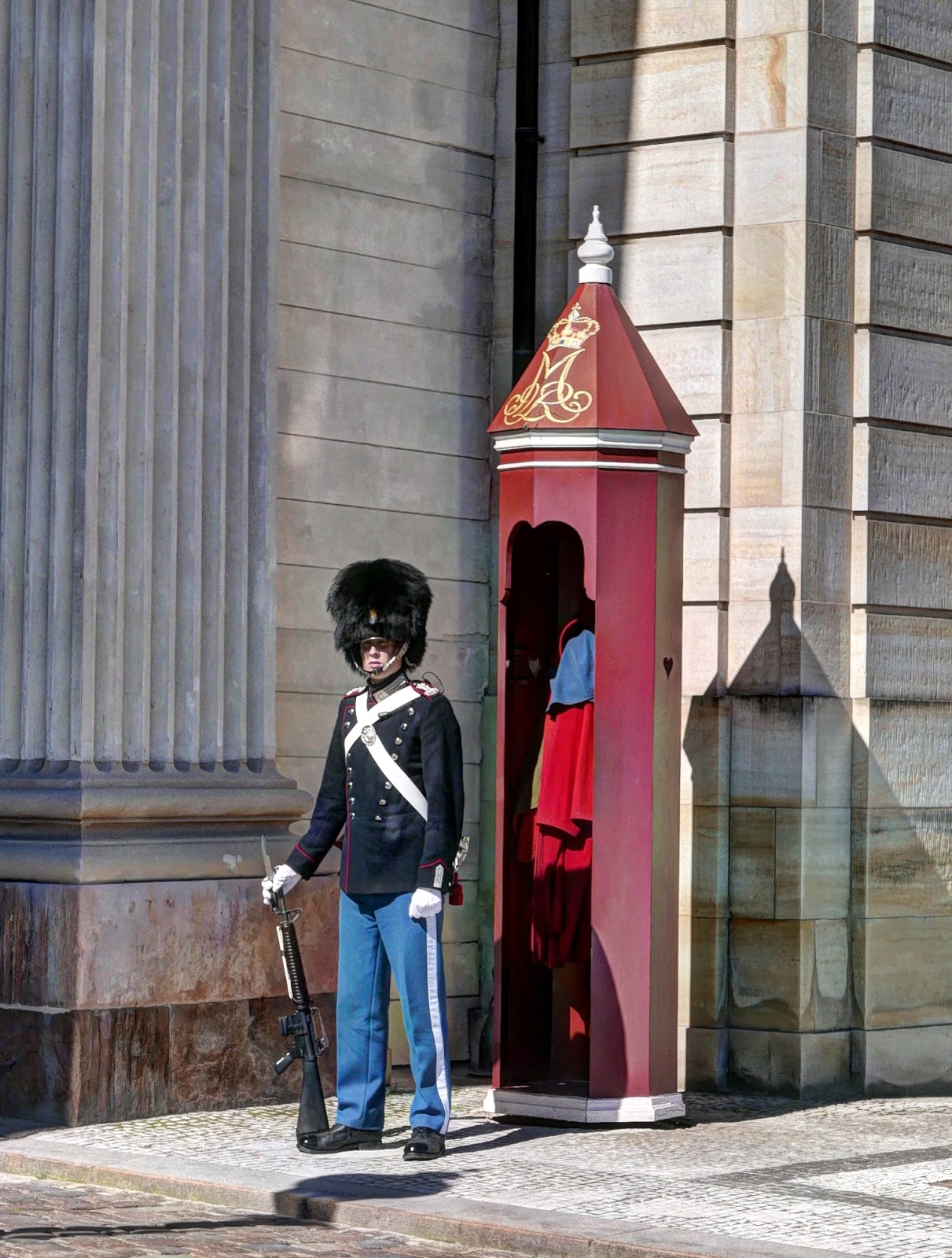
There currently is a Queen of Denmark, Queen Margarthe II, who is the figurehead of Denmark, and she lives in a large palace in Copenhagen.  She wasn’t available for a photo, so I took a picture of one of her many guards.  They wear these furry hats throughout the year, including summer!  They probably use the bald headed soldiers in the summer.


They have lots and lots of statues in Copenhagen.  This is another country that has been around for at least a thousand years and was a successful trading country.  It also was a bit of an empire builder hundreds of years ago.  As such, it often found itself challenged by other countries.  The harbor of Copenhagen had more than one fort to protect it from other countries and pirates.  Here are a couple of the gates of the fort near where our Viking ship docked.  It is still an active fort, but tourists are allowed to wander through parts of it a portion of the day.


Copenhagen, as well as the rest of Denmark, was occupied by the German Nazis.  During WWII, Denmark had a king, and he would not leave his people.  He stayed, and history reports he rode his horse daily through the streets of Copenhagen to let his people  know he was with them and wouldn't flee.  One reminder of WWII is this Anglican Church, St. Albans, which is an English Church.  It was part church and reminder to the Danes of Winston Churchill, who they respect greatly.


There is one statute that is not complimentary of the Danes.  Part of the trading history includes trading slaves and using slaves.  During the Danish empire days, they had the Virgin Islands as part of their little empire.  The used slaves for ‘white gold’, which we all know is sugar.  It took a lot of workers to grow and harvest sugar.  The Danes abolished slavery in the 1840’s, as it was seen as immoral.  If you look closely, you’ll see the field tools for sugar harvest.


We walked about four miles according to our guide and saw several beautiful parts of the city, like this fountain at the City Library:


Less beautiful but more interesting is this building and smoke stack:


It’s an incinerator for all the garbage of Copenhagen.  It even burns garbage shipped from England.  Supposedly the smoke is harmless and they generate a lot of energy here.  But there is more.  The slope on the left side of the building was engineered as a ski slope where in the winter time they have artificial snow.

I have not mentioned that we have three theaters on the ship and can attend movies and lectures.  While we love movies, we are attending the lectures about the Vikings, the Russians, Hans Christian Andersen, and several others which have proved to be very interesting.  


Monday, June 17, 2019

49!


From Poland, our ship travelled to the German port city of Rostock.  We knew from the cruise information that Rostock was to be a place that Viking would provide train travel to Berlin. However, the train ride was to be 3 1/2 hours each way. We would have only a few hours to spend in Berlin.  We were already there just a few years ago.  

So we opted for the Rostock tour, which was only 1 1/2 hours.  It’s in the German state of Pomerania.  The word Pomerania means by the sea.  The little toy dogs called Pomeranians are in fact from this region and can deal with snow and cold weather.  

Our expectations for this day were even lower than the day before as we were convinced after two spectacular days, this would have to be an off day.  And it kind of was, but wasn’t.  


Our guide took us to ‘main street’ and it was very pleasant.  They had corporate picnics taking place and it looked like the food and beer were plentiful.  This is Germany, the country that is third in beer consumption per person.  The whole park was packed - and having fun at 10 am in the morning.


Our guide probably knew he had a limited number of picture opportunities so he entertained us with stories - factual, we think.  Rostock was part of East Germany back in the Cold War Years.  Back then, to own a car, you ordered the East German Trabant then waited 15 years to get it. 


It had no heating or air conditioning system, it was small, and looking at it, you’d think it could be manufactured quickly.  Most German families during the Cold War had the parents and three children.  So when you finally got the car and took a vacation with the family, it was very interesting as you had few places to store luggage let alone squeeze the family into the car.  They say it was very quiet, however.  It was so small that in your tucked position your knees covered your ears and couldn’t hear the engine or muffler.

Another fact is a citizen can drink beer legally at age 16, and can drive legally at age 18.  You learn to drink first, then you learn to drive. We have it reversed.  BTW, DUI is at 0.5% blood alcohol in Germany, same as Utah, I believe. 

Dogs have to have Doggie Passports.  They cost 15-80 euros per month depending on dog weight.  Pomeranians would likely be in the ‘low cost’ 15 euro per month group.  The passport entitles the dog to be off leash, travel throughout Germany, and be with it’s owner most anywhere. 


Last but not least, Pomerania gets 70% of its electricity from wind turbines and 20% from solar.  They achieved their goals ahead of time, not decades after they set the goals.  

One last picture of Rostock.  After all the facts and stories, we were taken to a couple of pleasant locations.  Here is their City Hall:


On this trip we discovered some nice people from Michigan who grew up and live in Grand Rapids, Michigan.  This is where Shari was born and raised as well.  We also happen to have the same wedding anniversary date, so the four of us celebrated tonight at the upscale Italian restaurant on our ship.  


We have been married 49 years, and they have been married 37.  

It was a relaxing day, a surprisingly interesting day, and It was a prefect day! 

Sunday, June 16, 2019

Gdansk, Poland


After visiting a Fairy Tale city (Tallinn, Estonia), shouldn’t there be a let down?!?  I expected it, but it didn’t happen.  Our follow-up stop, Gdansk, was a port city of Poland with an incredible history.  Europe is far different than the U.S.  We are fortunate to have two large oceans separating us from Europe in the east and Asia in the west.  We have had 200+ years of little interference.  Many of the countries in Europe, especially the smaller ones, have had to endure multiple occupations from usually more than one empire or the other.  They endured the two major world wars, and their history is typically 1000 years or more.

This is the Gdansk as seen at the end of World War II:


80% of the city buildings were badly damaged or destroyed by the Russians as they moved westward toward Germany in 1944.

Here is our first view of the heart of Gdansk in 2019: 


The black and white picture (first picture) shows the Town Hall with much of the tower removed.  The Poles rebuilt the tower and buildings around it, and now it looks as follows:


Some of you will remember that World War II officially was declared after Germany invaded Poland on September 1, 1939.  Most of the rubble from the bombing is seen only in photos.  80 years after the war, the old architecture has been restored.  BTW, an indication of the the space inside can be predicted by the number of windows across the front of the building.  We were told 3 across is much preferred over 2.  Houses were taxed by width, so typically you can save on your taxes if your house is 2 windows wide.


During the tour, a monument to the Fahrenheit thermometer was pointed out.  It’s inventor was Daniel Fahrenheit, and his family home is in this city.  The U.S. is the only country to still use it as the standard for gauging temperature.


While Gdansk is quite the shipyard for Poland with many cranes and containers, our favorite dockside view looks like the following:


We have been to an onboard class about amber.  Gdansk is the world capitol for amber.  I think we’ve pointed out that it’s a product of tree resin from very ancient trees.  We learned at the talk that 82% of amber sold throughout the world is fake. Shari now has some new authentic jewelry that is quite becoming.


We learned that the beautiful facades of the buildings supposedly indicate what centuries they probably come from.  The ones with curves are from the renaissance period from 1400-1700, and the ones with straight lines are and no curves are from earlier times (medieval).


On the way back to our ship, our guide talked of optimism of being a free Poland, the war far behind them and the communists no longer in charge.  It seemed very evident they have much to be proud of.