Friday, May 24, 2013


Day 11

Anniversary Dinner

We woke up early at our beach hotel with the sun streaming through our windows. We were so excited to finally have sun. After-all, it has rained at least part of every day we have been in Italy. Guests came down for breakfast wearing shorts and swimming suits, but before we left for our next destination, the storm clouds formed and there was no sun. 

We drove the 90-min. drive in the rain to Imola, our next destination. This is where we had the most wonderful meal two years ago, and we came here to experience this meal again in honor of our 43rd wedding anniversary.  


After checking into our hotel in the old part of town, the simple kind of hotel we seek out, we put on our best clothes and walked to the restaurant. We were the first people there, and as before, we had two men waiting on us. Plus, the owner was walking around making sure all six courses of food and the four courses of wine arrived at just the right time. 

We had three appetizer courses. The first was goose liver with wine jelly and cooked apple. This went with wonderful champagne.  We discovered goose liver is excellent! 


The second appetizer was red mullet fish with potato. The third appetizer was a dish that’s difficult to explain. It was an egg with the most orange yolk that was boiled for 4 1/2 mins., then shelled and rolled in bread crumbs with more egg and fried for 30 seconds in sunflower oil. Our waiter said this is the best oil for frying. This egg was still in it’s oval shape when presented to us on a layer of potato and a bottom layer of sour cream.  This is a dish we would like to have again and share with others.  During the second and third appetizer, we were served an excellent Sauvignon Blanc.


The next course was pasta gnocchi made with red potato and added peas, tomato, and black truffle. 

The main course was pigeon breast, pigeon leg, and asparagus wrapped in bacon (but not like our bacon) served with a very delicious red wine. After learning about pigeons in Orvieto (Days 4-5) and being told it’s a popular item to eat, we were excited to finally try it....and we both loved it.  


Our dessert was various chocolate delicacies and a dessert wine. After 2 1/2 hours, we were finally finished!


We love this small town. Our hotel gives us bikes to ride, but the weather isn’t conducive to riding bikes. It’s flat with sidewalks and bikes lanes. Drivers drive sanely, so you don’t feel like you are going to get run over.  Although we have a car but taking a train here is easy.   We did find a dry window of time and walked to the fort designed by Leonardo da Vinci.  A 2 1/2 hour meal requires a lot of walking.


Thursday, May 23, 2013


Days 9 and10

What a difference a day makes! Yesterday we were in the beautiful mountain village of Norcia staying in a four star hotel (or five?). The included breakfast buffet this morning offered food that  was  grown in the area, such as fresh milk and yogurt, soft pecorino cheese, fresh ricotta, jams from the village, fruit from Italy, fresh eggs with deep orange yolks, and the meat....oh, the meat...like the boar and pig pecorino and salami that we wrote about yesterday. There were also several pastries made on site, fresh squeezed orange juice, and various individually made coffee drinks.

After breakfast, we left  to drive up and over this beautiful mountain range. The directions on map quest said things like “series of curves”, “very steep grade”, over and over again. And there were many tunnels. The driver and co-pilot did well, and after a couple of hours we arrived at the Adriatic coast. 

One thing you notice in much of Italy is how many farms you see, even in the mountains. They earn their keep as the breadbasket of Europe.  And the land is not all dedicated to grapes and olives.  Also, we saw hundreds of solar panels on south facing slopes at dozens of locations.  We had heard when Chernobyl went radioactive back in 1986, the Italians decided to close existing nuclear plants and not build any new ones.  It always seems like solar would work in St. George and the sunny parts of the west.  

After an hour of driving along the coast, we arrived at our hotel. This is a resort area that the average Italian family can afford to bring their family to the beach.  The problem is, this is an unusually wet and cool spring, and the place looks deserted. Many resorts are very run-down, many look permanently closed, and plants are growing over the sidewalks. This is the view from our room:


This doesn’t look like the peaceful Adriatic we know.  The die-hard beach goers are without bathing suits.  

Our hotel is listed as a three star hotel, but our room makes it seem more like a two-star hotel. It’s very small with an uneven bed, and we don’t even have soap or shampoo!!! The only good thing is that it’s one of the few rooms that fully faces the Adriatic. We have a sliding door. and we can walk out onto a tiny deck and watch what WOULD have been the beach action during the high season. There are all these beach umbrella stands and folded-up chase lounges going for miles along the sandy beach, but no one is using them. 

Day 10

We are staying in Fano to enjoy the beach, but also to visit the popular walled hill city called Urbino.  On a whim, we were looking for new and hopefully exciting places.  Urbino is a UNESCO World Heritage Site - we are not sure what that means but it sounded impressive.  We headed into the mountains where it is located. 

Urbino is noted as the birthplace of Raphael, who was one of Michelangelo’s competitors when the Pope choose Michelangelo to paint the Sistene Chapel, the Pope’s Chapel at the Vatican.  Raphael left Urbino at the age of 16, and we didn’t find any of his works in his home town.

More noteworthy is Duke Federico, who inherited the dukedom of Urbino.  According to historical records, he was a born leader who was very skilled at leading armies and fighting - good skills to have in the 15th century.  During one of the many battles he fought, he lost the sight in one eye.  After this happened, it is said he cut off the bridge of his nose in order see over it with his remaining eye.  Hence, all paintings of him thereafter were a profile of his good side.  Also important was that he was rich and he loved the arts and architecture.  We visited his Palazzo Ducale, the Duke’s Palace.  


We have been telling you not to judge a book by it’s cover.   His palace is to the left of the Urbino Duomo.  It is about a block long and a block wide.  


Since it was raining, we were more than willing to tour the three floors.  There is an interior courtyard the size of four pickleball courts (one tennis court).  We managed to find the old well and the pulley that was used to pull up buckets of water back when pulleys were the latest technology.

We wandered through the many floors of art work left by the Duke, but what was most impressive were all the fireplaces the palace has.  Here is one of probably 20-30 examples from this one palazzo:


There wasn’t a speck of furniture in the Palazzo, but lots of art work (not shown), people to make sure you didn’t touch the art work, and a fireplace in every other room.  We understand wood heat and the amount of wood it takes to make a modest house warm.  The Duke must have had at least a couple of ‘foresters’ busy for much of the year gathering cord wood.

We did stumble upon a ristorante (restaurant) that looked enticing.  For those traveling to Italy, ristorante means most expensive Italian food.  The name of the place was Osteria, another kind of eatery which normally has very good food but not expensive as in ristorante food.  One of us got to try rabbit with endive which was good.


Our experience was tempered by the rain, so we didn’t see the many vistas the town has to offer. 

We finished the day with seafood in Fano.  It is the off-season for tourists, but not the off-season for fish.  Buon Appettito!


One last thing.  We have met many people on our trips.  While the people at our Fano hotel are not the richest, they are the friendliest.  We’ve had so many people come up to us and talk even though we don’t know Italian well enough to talk above a 1st grade level and keep trying to have a friendly conversation.  We love it!

Wednesday, May 22, 2013


Day 8
National Park Day

This morning we walked our suitcases down the steep, narrow, cobblestone street to our car anc managed to find our way out of Perugia. Our plans originally were to use Perugia as a base for a day trip to Assisi, headquarters of the Franciscan monks and their ancient monastery.  However, as we mentioned yesterday, Perugia was a bit too confusing for driving, so the day trip was canceled.

Therefore we decided to make a quick stop in Assisi on our way to our next destination. This short visit just wet our appetite to go back again on a future trip when we can spend more time.  St. Francis, for whom the monastery is named, devoted himself to helping the poor and nature.  Assisi is very grand in terms of the size of the buildings. It is very beautiful, clean, and doesn’t suggest poverty. Following is a picture of Assisi.


We stayed less than an hour in Assisi since we planned to meet Paola, our Italian cooking school owner, in the beautiful mountain town of Norcia, our next destination. It is now  one of the towns they have on their interesting schedule of places to learn to cook and enjoy Italian life.  We were in one of their 2010 cooking schools in Soriano, Paola’s home village, and loved it. It turns out that this is one of their cooking weeks in Norcia.  Besides seeing Paola, we also got to meet up with Spartico, our 2010 guide, who is also leading this Norcia tour.  We also got to meet the current participants and had dinner with them this evening.

What you see above looks like a meteor or big lump of coal.  It, and the similar looking objects in the basket, are truffles, a very unique fungi prized for it’s unique flavor.  We are used to sampling the truffle in truffle oil which is far more affordable.  It’s hard to imagine the value of a black truffle this size.  We did notice signs along the nearby highways warning against fungi hunting in this region without a permit.

The area is also noted for the hams produced from a type of Italian pig and also meats made from wild boar.  


There must have been at least two dozen deli-stores in this tiny town, all selling cured hams, salamis, and cheese and most of them wanting you to sample their meats and cheeses.  There are even some cheeses with small bits of truffle in them.  Wild boar is regularly hunted here, and their heads adorn most of the shops.  IF you double click on the picture, you will see the hams and salamis in the display windows.

Since Norcia is in the mountains, it was an adventure getting here. The two-lane road was very curvy with many tunnels. Of course, the Italians pass when we think there just isn’t enough time.

We are staying in Norcia at Palazzo Seneca, a small palace.  We were given a pleasant surprise in that we are in a suite that has 2.5 bathrooms, a living room, and a very spacious bedroom.  It added to our La Dolce Vita!

Monday, May 20, 2013


Days 6 and 7

Day 6

We left Orvieto this morning in our little Fiat. We were sad to leave this wonderful hill town but excited to have a new adventure in a place we have never been before -- Perugia (remember Amanda Knox?), a walled city of 200,000 people. We took the scenic way, driving along on hilly, winding roads alongside fields of red poppies, villas, olive trees, and grapevines. Elisa, from our Orvieto hotel, had printed out the Map Quest directions. The only problem was  they were in Italian. We thought we would be OK, but we didn’t know how big and hilly Perugia would prove to be. When we got close, there was one turn after another, and the co-pilot couldn’t keep up and we were soon hopelessly lost. We just kept going up the hill towards the central district at the top. We parked the car near a lively pedestrian-only street and set off to find someone to help us. We ended up at Hotel La Rosetta. 


The woman at the desk said our Hotel Priori was in the medieval district, very close if we were walking but very difficult to get to by car. She tried to give directions, but there were many very steep and narrow one-way cobblestone streets to navigate, and we didn’t think we could do it especially without a map. 

We asked if there were any rooms available at La Rosetta for two nights, and there were, so we decided to stay right there!!! The woman helped us cancel our reservation, the butler parked our car along a narrow hilly street, and we got settled into this very old four-star hotel. The walls are so thick that we can only get the wi-fi signal in the lobby. Our door and windows are so thick and tight-fitting that we can’t hear any noises from other rooms or outside, but when the windows are open, we can hear the lively street noises below....people talking, laughing, and music. I guess we won’t be driving to Assisi tomorrow as planned. We wouldn’t be able to find our way out or back in! 

 Day 7

Perugia is a small city built on two mountain tops.  We normally associate elevation change with recreation trails, not parts of a city, but Perugia is an exception.  We’ve seen only one person pedaling a bike so far, and they had an electric motor for assistance.  The streets we were to follow to our ill-fated hotel reservation are all alike - none are straight, none are level, and all seem very narrow..


We took a quick one hour bus tour of the city on a very small tour bus with narration over headphones at our seats.  While this is a beautiful city, we don’t have the time to walk to all the sites due to the size and hilliness of the city.


The city has many walls.  They were used centuries ago to ward off invaders.  There is an Etruscan wall built over 2000 years ago, walls built by the Romans after they defeated the Etruscans, and finally walls built in medieval times about 1000 years ago.  And they are still standing!   Stone masons probably didn’t suffer from unemployment in Perugia back in the day.  

We especially like their man-made arches.  The following picture is taken from within an arch looking at an arch with smaller arches.  If you know your architecture, you can probably tell what centuries the stone work comes from.  We are simply impressed by the beauty of all the stone work.


The sculptors’ hands are seen in places to enhance the churches and piazzas.  In the Piazza IV November Piazza, there is the Fontana Maggiore(below).  

and the following modern sculpture at one of many Catholic churches.

pastedGraphic_5.pdf


By the way, the significance of the name ‘Piazza IV Novembre’ seems to be a mystery.  4 November should tie to an event, but we’ve asked and are yet to find a good answer.  If you have one, comment on the blog please.

For those of you in Seattle and Grand Rapids, Perugia is a sister city.  We didn’t see anything celebrating Seattle or Grand Rapids other than a sign when we were trying to find out way into the city.

We were going to say that there is not much to recommend about Perugian food.  Once again, we are in a city where the bakers don’t use salt in their bread.  We learned on our bus tour that about 500 years ago, the pope of that time tried to raise money by taxing salt.  In this city state, they decided not to pay.  Wouldn’t you think they’d be over it?   However, our dinner was at another one of those unpretentious small places off the beaten path. The following is a picture of the door into the place.  

pastedGraphic_6.pdf

Hours later after a simple dinner of local organic food, we were satisfied that we had another special meal.

pastedGraphic_7.pdf

Tomorrow we face the challenge of finding our way out of this unique city to Assisi and Norcia.  At least we have had a good dinner.

Saturday, May 18, 2013


Days 4 and 5

We left Florence in our new rental car on a rainy morning.  It was a bit of a shaky start as the car booking was for June 17, not May 17.  We prefer that the first moments of driving in Italy go smoothly instead of having a rocky start (rain, wrong car, and wrong reservation date).

The day smoothed out after a two hour drive to Orvieto.  It is such a beautiful small city and sits atop a 300 foot tall volcanic bluff with steep cliffs on every side.  We had been here a couple of times for just a couple of hours on two visits.  This time, we are spending two days in an excellent hotel called Hotel Duomo.  It’s in the heart of the city and very close to the Duomo.


It’s a huge cathedral right in our backyard.  


The front in quite spectacular and it is the main attraction in the city.

The city is probably no more than a mile long and a half mile wide at it’s widest spot, and most of the buildings remind us of the renaissance . . . 


or medieval times.


The city is even older than dirt, as the Etruscans founded the original city around 800 B.C.

During World War II, the town was spared from Allied bombing, thankfully.  After the Italians surrendered to Dwight Eisenhower and the U.S. in 1943 (yes, long before the Germans and Japanese surrendered), a request was made to not bomb Orvieto primarily because of the Duomo.  It wasn’t defended by the Germans, so our pilots left this unique city alone.

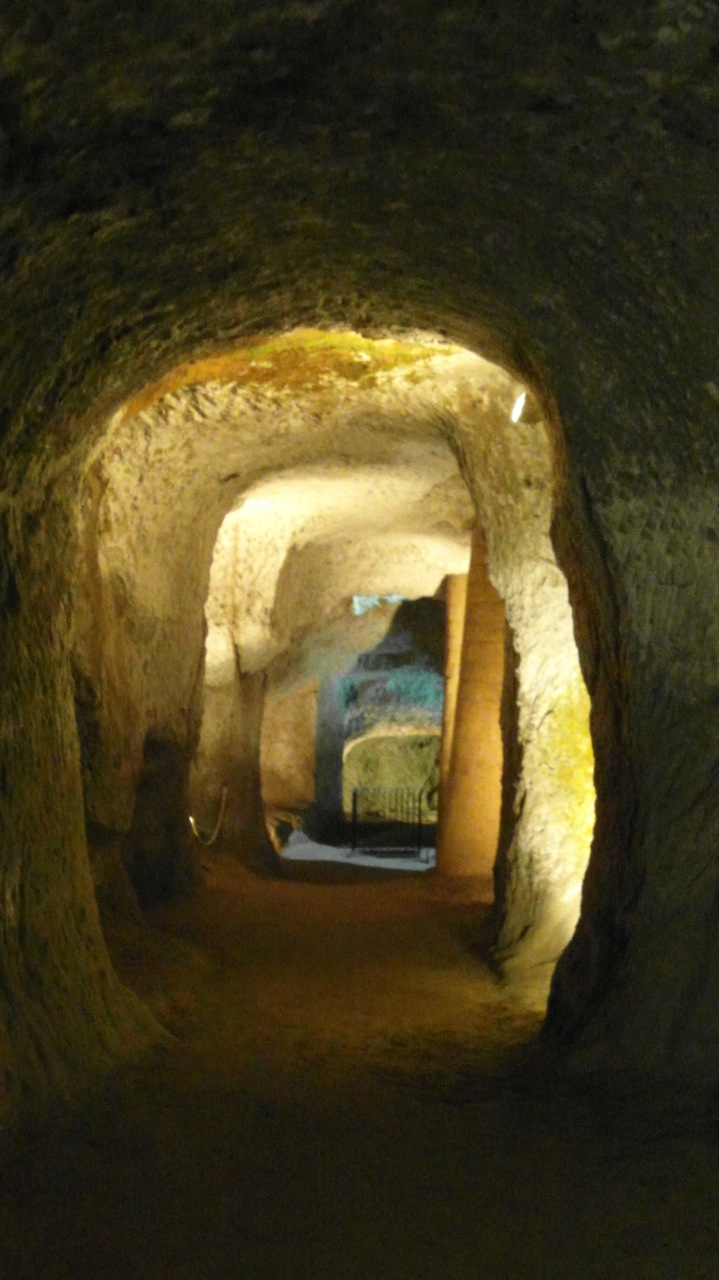
Having a couple of days to check it out, we toured the hidden side of Orvieto.  There are over 1000 caves under the city on this lava butte, all man-made.  In the time of knights and the bow and arrow, the butte city was a great place to defend against the barbarians.  However, water was a bit of problem.  Starting in Etruscan times, the inhabitants built downward and tunneled to the water.  We toured a couple of the public caves used also during the renaissance.


They used the excavated material to make bricks above ground for building houses and put their olive oil presses below.  Where they thought they would find water, they tunneled vertically like this well that is slightly less than 3 feet by 4 feet.  This hole is about 300 feet deep and was dug by men with hand picks.  If you question how could they build this, look hard and you’ll see toe holds which are located on both of the long sides. 


The flash didn’t reach the bottom, of course.

They had water thanks to the vertical tunnels, and they also collected rain water in the horizontal tunnels immediately below their houses.  

Man doesn’t live by water alone.  Barbarians loved their food, too, and commonly used starvation as a weapon.  The inhabitants of the city back in the city siege times figured out a very clever solution.  They dedicated some of the caves to pigeon raising, and it’s estimated one mile of caves looked like this:


and this:


Pigeon was the chicken of the day back then and the 5-6 inch holes were pigeon apartments.  The pigeons would fly out the window (these caves were just inside the cliff surface and a pigeon window was for their egress and ingress) and eat or bring foraged food back to their young.  No pigeon recipes were discussed during the tour, but we hear it’s not that bad.

All the caves conveniently register 15 degrees Celsius year round, and 80% of the caves are privately owned.  Most are used for wine cellars in today’s Orvieto.

We will only mention that the food is BETTER here than in Florence.  First, in Florence they make their bread without salt.  You would assume it to be a very small omission, but it’s not!  Thus, the bread for all you gluten eaters is excellent here!  Second, great food is inexpensive here compared to the big city of Florence - about half the price.  Here are couple of food pictures with short captions for you epicureans.

Smoked Goose Breast with Goat Cheese. 
Perfetto!

Gnocci with bacon, spinach, and truffles
Little finger nail size gnocchi


Nidi di rondine pecorino e miele caldo
Translation:  Swallows' nests cheese and warm honey
pasta with cheese like you have NEVER had!

There is a celebration of spring flowers here in Orvieto for two days.  Unfortunately, I didn’t get the message that a corsage was in order for my sweetheart.  


Thursday, May 16, 2013


Day 3

Shari had read a non-fiction book on the plane called “90 Days in Florence”, so part of Day 3 was spent exploring the residential neighborhood of the story -- a place that is quiet and friendly and only a 15-minute walk from the center of the city where the streets are crowded with tourists and the museums are found.  The story is about an American from Michigan whose grandmother had told her stories of her life in Florence.  She visited Florence and surrounding areas several times in the past, but she always wanted to stay longer. On this trip she was able to leave her job and stay for three months. 

One thing of interest for us are the open-air markets, and this neighborhood has one.  The centerpiece of traditional Italian markets are the fresh foods, and they take up the biggest portion of the market - unlike supermarkets.  For real food enthusiasts, seeing and buying fresh and beautiful fruits, vegetables, herbs, meats, cheeses, and fish can make food shopping a special part of your day.   


As we have seen most of the museums in Florence on other trips, we spent most of our time walking around, exploring, and occasionally stopping in cafe bars and gelaterias.  There is no end of places to stop in for a coffee, gelato, pastry, or a glass of wine within a given block.  We’d like to say we know how to choose the best, but we can at least say we’ve picked well most of the time.

We don’t like admitting that it rains in Italy, but when it does during meal time, we have a   special place about a 100 yard dash from our hotel.  The food is very good and the staff is friendly.  You’ve probably heard the Italians are friendly, and they are -- even if you don’t try to speak their language. But if you do, it is even better. These two handsome Italians were our two waiters. Of course, you know the other handsome Italian in the middle. 


For our last night in Florence, we tried still another new restaurant called Buca Mario.  This was a $$$ restaurant ($ = cheap, $$$$$ = very expensive) and very enjoyable for both the food and the ambiance.  The premiere form of mozzarella cheese in Italy is made from water buffalo milk (not from bison).  Coupled with ripe tomatoes, basil, and olive oil, it’s almost a meal in itself.


You may be tiring of so many food pictures, so I’ll spare you the photos of risotto with fungi and the pappardella with wild boar sauce.  I guess they liked us a little as they gave us an apron as a going away present.

Tomorrow we head to Orvieto, the first of several small cities we’ll visit.  Most will be first timers.  We’ll be driving a car, something we do rarely in Italy.  It’s usually provides a certain amount of excitement all by itself.

Europe 2013


Days 1 and 2

Things are off to a bit of a rough start for our European vacation.  We understood that taking our cell phones to Europe would be expensive and a bit distracting.  For the purpose of relaxation and to save money, we left them home and suspended the accounts.  When we got to Florence and tried checking our email on our computer and iPad, our Google account didn’t trust our efforts at signing onto the account from such a foreign land, and won’t let us into Shari’s mail account, and only a portion of mine.  I can get email, but only if I sign on through the internet to the google website.  Email was to be our way to communicate with friends and family, and it will be a bit more difficult.

The good news is that the flights were better than we remembered in past years.  We still have not figured out how to sleep on a plane, so we arrived tired.  Once on the ground in Florence, our energy level spiked for a few hours from the excitement of being in Italy again.


I tried to clear all the thousands of touristas for the Duomo picture event!  Got most of em.

After sleeping like a couple of logs in a quiet forest, our second day was spent walking the uneven streets and taking in all the sites and people.  Some of the streets remind us of why we  avoid renting a car in the big cities.  Some streets are so narrow they would make a good bike trail and the sidewalks a foot path.


After a couple hours of exercise and window shopping, we tried a new restaurant that was highly recommended by our son, Lee.  As it turns out, it is seen very favorably by Frommers, the travel guide folks, as well.  It’s one of the oldest continuously operated restaurants in all of Italy, having been in business since 1869.  In Italy, you don’t judge a restaurant by it’s street facade.


It is a popular place, so you occasionally have to share your table as we did with Gary Lum from San Jose, CA.   


A restaurant in business for 144 years must have some endearing attributes.  They have a chicken dish grilled briefly then pan fried in butter that is outstanding.  The chicken and the steaks are grilled on an open wood fire in the kitchen.  It was a nice start to the Epicurian part of our vacation!


For those of you new to the Blog World, you can click on a picture and it's supposed to enlarge for a better view.  We'll have our fingers crossed that this works for you!!